WireGuard: A Modern VPN Protocol in 4,000 Lines of Code
WireGuard
WireGuard is a strikingly small and fast VPN protocol and implementation built on the Noise protocol framework and ChaCha20-Poly1305. It has been mainlined in the Linux kernel since 5.6 and now runs on macOS, Windows, iOS, Android, and the BSDs.
Compared with OpenVPN or IPsec, the defining trait of WireGuard is how much it chooses not to do. There is no TLS, no certificate chain, no cipher negotiation, no optional modes. The paths, the key exchange, and the cipher suite are all fixed. In return, the Linux kernel implementation fits in roughly 4,000 lines of code — and the cryptographic properties have been formally analyzed.
Key Facts
| Name | WireGuard (core) / wireguard-go (userspace implementation) |
|---|---|
| Repository | github.com/WireGuard/wireguard-go (official mirror) |
| Stars | 4,500 (as of 2026-11, wireguard-go) |
| Forks | 1,700 (as of 2026-11, wireguard-go) |
| License | MIT (wireguard-go) / GPL-2.0 (Linux kernel) |
| Primary use | Point-to-point encrypted tunnels · site-to-site VPN · remote-access VPN · overlay networks |
| Category | Networking / VPN / Security |
Architecture
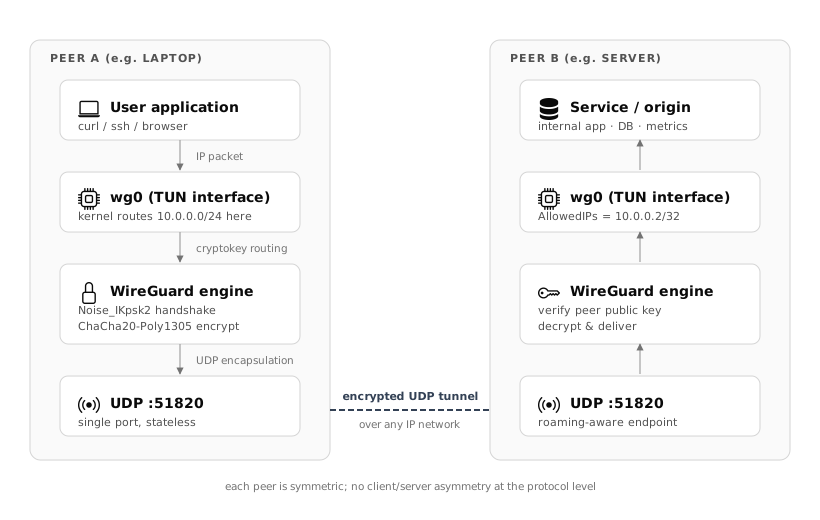
WireGuard's model is not "client and server" but a set of symmetric peers. There is no configuration-level notion of an initiator or a responder; every endpoint has the same wg0 interface and just needs to know the other peer's public key and reachable IP ranges (AllowedIPs).
Data path
- An application sends an IP packet — to the OS,
wg0is just another routing destination - The kernel routes the packet to the WireGuard interface — e.g., anything destined for
10.0.0.0/24goes towg0 - Cryptokey routing picks the peer that owns the destination IP and encrypts with that peer's public key
- UDP encapsulation sends the ciphertext to the peer's endpoint (
IP:51820) - The receiver walks the inverse path and hands the decrypted IP packet back to the OS from its own
wg0
Key exchange is traffic-driven; there is no explicit "connect" step. The first outbound packet triggers a handshake, and session keys rotate every ~2 minutes thereafter.
Cryptographic primitives
WireGuard treats "cannot be chosen" as a design goal, not a limitation. The primitives are fixed:
- Key exchange: Curve25519 (ECDH)
- Hash: BLAKE2s
- AEAD: ChaCha20-Poly1305
- Key derivation: HKDF
- Handshake: Noise_IKpsk2 pattern
- Replay protection: TAI64N timestamps
Because there is no cipher-suite negotiation, downgrade attacks and misconfigured cipher selection are architecturally impossible. If a primitive ever needs replacing, the choice is deliberate: bump the protocol version — i.e., ship a new protocol — rather than negotiate.
Cryptokey routing
WireGuard's cleanest piece of design is cryptokey routing. In most VPNs, "which key do I encrypt with" and "where do I route this packet" are two independent lookups. In WireGuard they are a single mapping: public key ↔ AllowedIPs.
 1[Interface]
 2PrivateKey = <base64 private key>
 3Address = 10.0.0.1/24
 4ListenPort = 51820
 5
 6[Peer]
 7PublicKey = <peer public key>
 8AllowedIPs = 10.0.0.2/32, 192.168.100.0/24
 9Endpoint = peer.example.com:51820
10PersistentKeepalive = 25
Outbound: find the peer whose AllowedIPs contains the destination IP, encrypt with that peer's public key.
Inbound: decrypt, then verify that the source IP of the inner packet is within the sender's AllowedIPs — if not, drop.
The outcome is that key authenticity = packet authenticity. You get IP-spoofing prevention at the network layer without maintaining a parallel ACL.
wireguard-go vs. the kernel module
There are two reference implementations:
- Linux kernel module (
wireguard-linux, in-tree since 5.6) — the production path; native performance - wireguard-go (github.com/WireGuard/wireguard-go) — Go userspace implementation for platforms without a kernel module (macOS, Windows, FreeBSD) or for running over
tun/tapdevices
Both expose the same wg CLI and config file, so cross-platform operations are identical at the command level.
Native Linux outperforms wireguard-go in raw throughput, but modern CPUs handle wireguard-go comfortably. For a small cloud instance running a site-to-site tunnel, either is fine.
How it differs from OpenVPN / IPsec
| Aspect | OpenVPN | IPsec (strongSwan, etc.) | WireGuard |
|---|---|---|---|
| Code size | ~100k LoC | ~400k LoC | ~4k LoC (kernel) |
| Runs in | userspace | kernel + userspace | kernel (Linux) |
| Protocol | TLS over UDP/TCP | IKEv2 + ESP | Noise + UDP |
| Auth | certs / passwords | PSK / certs | public keys only |
| Cipher negotiation | yes (cipher-list) | yes (proposals) | none (fixed) |
| NAT traversal | yes (UDP/TCP) | needs NAT-T | UDP by design |
| Connection setup | explicit handshake | IKE phases | traffic-driven |
| Config volume | large (.ovpn + certs) | large (ipsec.conf) | ~10 lines |
Two consequences matter in practice. First, protocol simplicity eliminates whole categories of implementation bugs and misconfigurations. Second, WireGuard has no "connected/disconnected" state — if your endpoint IP changes mid-session (a laptop hopping Wi-Fi ↔ LTE), the tunnel follows automatically. That is "roaming" in WireGuard terms.
When WireGuard is the wrong tool
It is powerful, not universal.
- User authentication in-protocol: WireGuard uses "public key = identity" and does not natively map to human user accounts. Tying it to SSO/LDAP is a management-plane concern
- Frequent dynamic access control: you own key distribution and revocation. A control plane (Tailscale, Headscale, Netbird) is the common answer
- TCP-only networks: WireGuard is UDP-only. If your path blocks UDP, you need a wrapper like udp2raw
- Regulated industries requiring FIPS-listed ciphers: fixed primitives work against you when compliance lists specific allowed cipher suites
Summary
WireGuard shrinks the protocol, the implementation, and the configuration each by roughly an order of magnitude. By doing so, it cuts the biggest operational risk of VPN work — "a configuration mistake breaks the crypto" — right at the source. Native kernel performance, cryptokey routing that unifies key management and routing, and location-independent roaming make it the default first candidate for modern VPN design.
For how to apply it in production, see WireGuard in Practice, which walks through three canonical scenarios: remote access, site-to-site, and mesh overlay.